AS 4970:2025 introduced the Notional Root Zone (NRZ). It did not retire the Tree Protection Zone (TPZ). Both terms are current, and they describe different things: the NRZ is a calculation, and the TPZ is the protection zone the project arborist determines from it.
Under the 2025 standard the NRZ is the calculated root-zone radius, and the TPZ is the protection zone applied on site. They are not the same figure. A report that uses the two terms interchangeably, or records one radius as both, does not meet the standard and will not withstand review by a Council arborist.
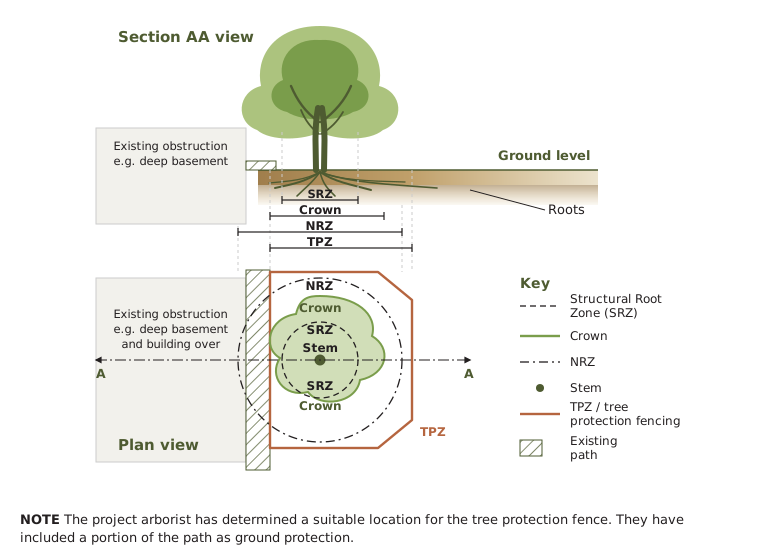
What NRZ is, and how it's calculated
The NRZ is the calculated root zone. Its radius is the diameter at standard height (DSH) multiplied by twelve, measured from the centre of the stem, with a minimum of 2 metres and a maximum of 15 metres (AS 4970:2025 cl. 3.2).
The calculation
NRZ radius = DSH × 12
DSH = trunk diameter at 1.4 m, measured from the centre of the stem. Minimum 2 m, maximum 15 m (AS 4970:2025 cl. 3.2).
For palms, cycads and tree ferns the NRZ is not calculated by this formula; it is set at not less than 2 metres (AS 4970:2025 cl. 3.2). The NRZ is not a protection boundary on its own. The standard describes it as the primary trigger for arboricultural input on a development site: it identifies that a tree is affected and gives an initial root-zone radius for assessment.
This is a change in terminology from AS 4970-2009, which had no NRZ. Under the 2009 edition, the calculated zone was the TPZ itself, with a radius of the diameter at breast height (DBH) multiplied by twelve (AS 4970-2009 cl. 3.2). The multiplier is unchanged, and the measurement point is unchanged: DBH and DSH are both taken at 1.4 metres above ground. What changed is that the calculated figure is now called the NRZ, and the TPZ has become a separate determination.
Why TPZ is still here
The TPZ is the protection zone applied on site, and the 2025 standard keeps it. The project arborist determines it from the NRZ together with the considerations the standard lists (AS 4970:2025 cl. 3.1, 3.3.2): the location and distribution of roots, the loss of root mass a proposed encroachment would cause, the species and its tolerance to root disturbance, whether a loss of soil volume is temporary or permanent, the age and size of the tree, overlapping root zones from nearby trees, and the construction measures proposed.
The NRZ is the input to that determination, not the result. Two trees with the same NRZ can be given different TPZs, because the considerations differ between them. The standard also allows the consent authority to specify a TPZ (AS 4970:2025 cl. 3.1), which applies where a Council condition has set the zone.
When you calculate SRZ
Encroachment is measured against the NRZ, not the TPZ. AS 4970:2025 classifies a proposed encroachment by the percentage of the NRZ area it affects.
| Class | Proportion of the NRZ area | Clause |
|---|---|---|
| Minor | 10% or less | 3.3.4 |
| Moderate | more than 10%, up to 20% | 3.3.5 |
| Major | more than 20%, or any encroachment inside the SRZ | 3.3.6 |
The Structural Root Zone (SRZ) is the area required for the tree's stability. It is calculated when major encroachment is proposed (AS 4970:2025 cl. 3.4). The SRZ radius is (D × 50) raised to the power 0.42, multiplied by 0.64, where D is the trunk diameter measured above the root buttress flare. For trunks under 0.15 metres the SRZ is 1.5 metres.
The calculation
SRZ radius = (D × 50)0.42 × 0.64
D = trunk diameter (m), measured above the root buttress flare. SRZ is 1.5 m for trunks under 0.15 m (AS 4970:2025 cl. 3.4).
What this means for your project
If you are preparing or reviewing a tree report on a development site, treat the NRZ and the TPZ as two separate steps, because the 2025 standard does. Set out the NRZ calculation, then determine the TPZ from it with reasons that address the cl. 3.3.2 considerations. Measure encroachment against the NRZ, and calculate the SRZ where major encroachment is proposed. A report that records a single radius as both the calculation and the protection zone has left out the assessment the standard requires.