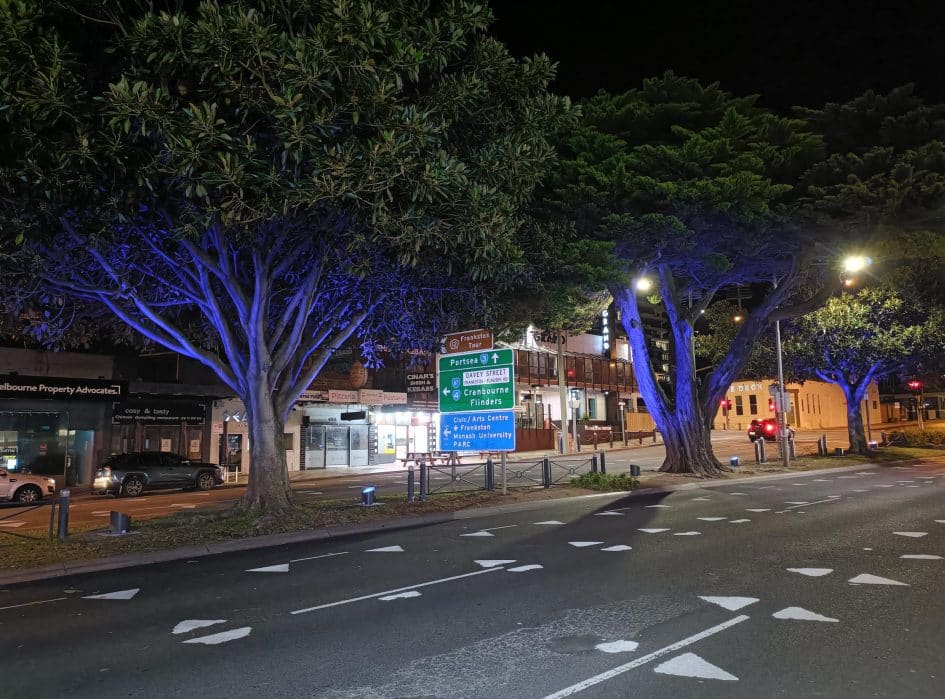
Frankston City Council wanted to uplight the canopies of the significant trees down the centre median of Nepean Highway within Frankston. The lights had to go into the ground, among the structural roots of large trees, in a median between two live traffic lanes. Arbor Survey were involved from the first concept meeting through to the final connection, and none of the trees declined as a result.
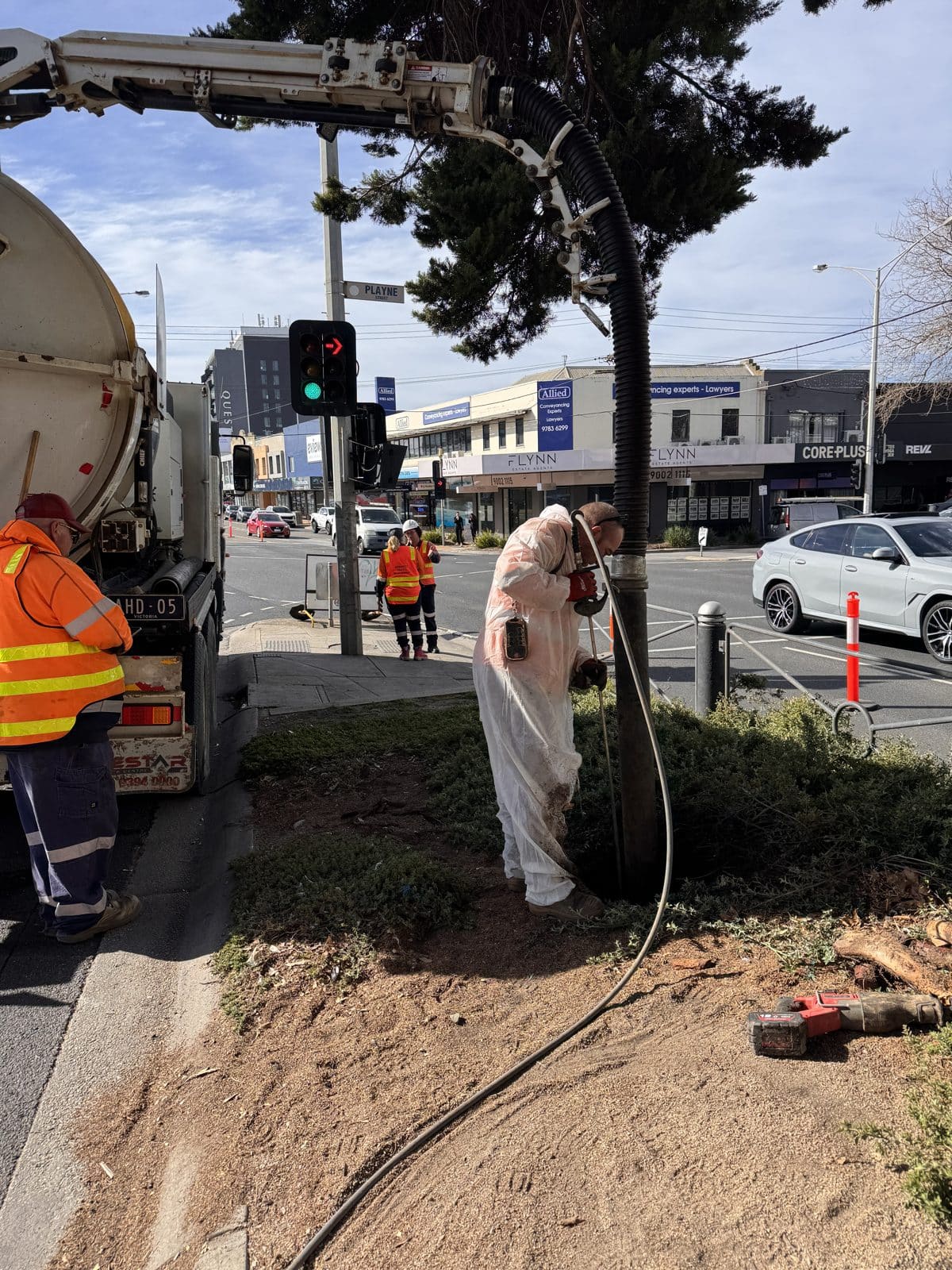
What Frankston wanted
A row of significant trees runs down the median through the township. Council wanted to light their canopies from below, so the trees stood out at night. In-ground uplights sit at or just below the surface near the base of each tree and throw light up through the canopy. That put the digging close to the trunk, right within the Structural Root Zone (SRZ).
Council brought Arbor Survey in at the concept stage, before the design was set. That is the right time to involve an arborist. If the lighting is designed first and the arborist is called only after the trench line is drawn, trees are removed to accommodate the service run.
Why it was hard
A centre median is one of the worst places to dig near trees. The growing space is narrow, with traffic lanes on both sides. The trees are large, so their roots fill the whole strip and run out under the road. Other services already share the median. Traffic management limits the hours you can work and adds cost. And the trees were the whole reason for the project, so damaging one to install a light would have defeated the point.
The usual way to install this is an excavator and a continuous trench from the supply to each light. On this median, that trench would cut a continuous band of roots the length of the planting. Under AS 4970:2025, this is a major encroachment, and on these significant trees, the risk was not worth taking. So the trench was out.
What we did
First, the survey. We assessed each tree and calculated its Structural Root Zone and Notional Root Zone (AS 4970:2025 cl. 3.2, 3.4). Those figures show where the roots that hold the tree up are, and how much room the works had to leave. The survey set where each light could go, and it flagged what the works would do to each tree before anyone dug.
After that, the job moved from assessing the trees to working out how to get the lights in without trenching across the roots. The answer was to go under the roots, not through them.
The main cable run went in by directional drilling, boring a line below the root zones from one end of the median to the other. AS 4970:2025 names directional drilling as the method for routing services through a Tree Protection Zone, with the bore kept deep enough to pass under the structural roots (cl. 4.5.5). At each light position we opened the ground by non-destructive digging, exposing the roots by hand and with air or water rather than cutting them. This is the minimally destructive method the standard calls for when locating roots (cl. 3.3.2(m)). Around thirty potholes went in this way. Each one opened a pit for a light housing and showed us where the roots were before anything was committed.
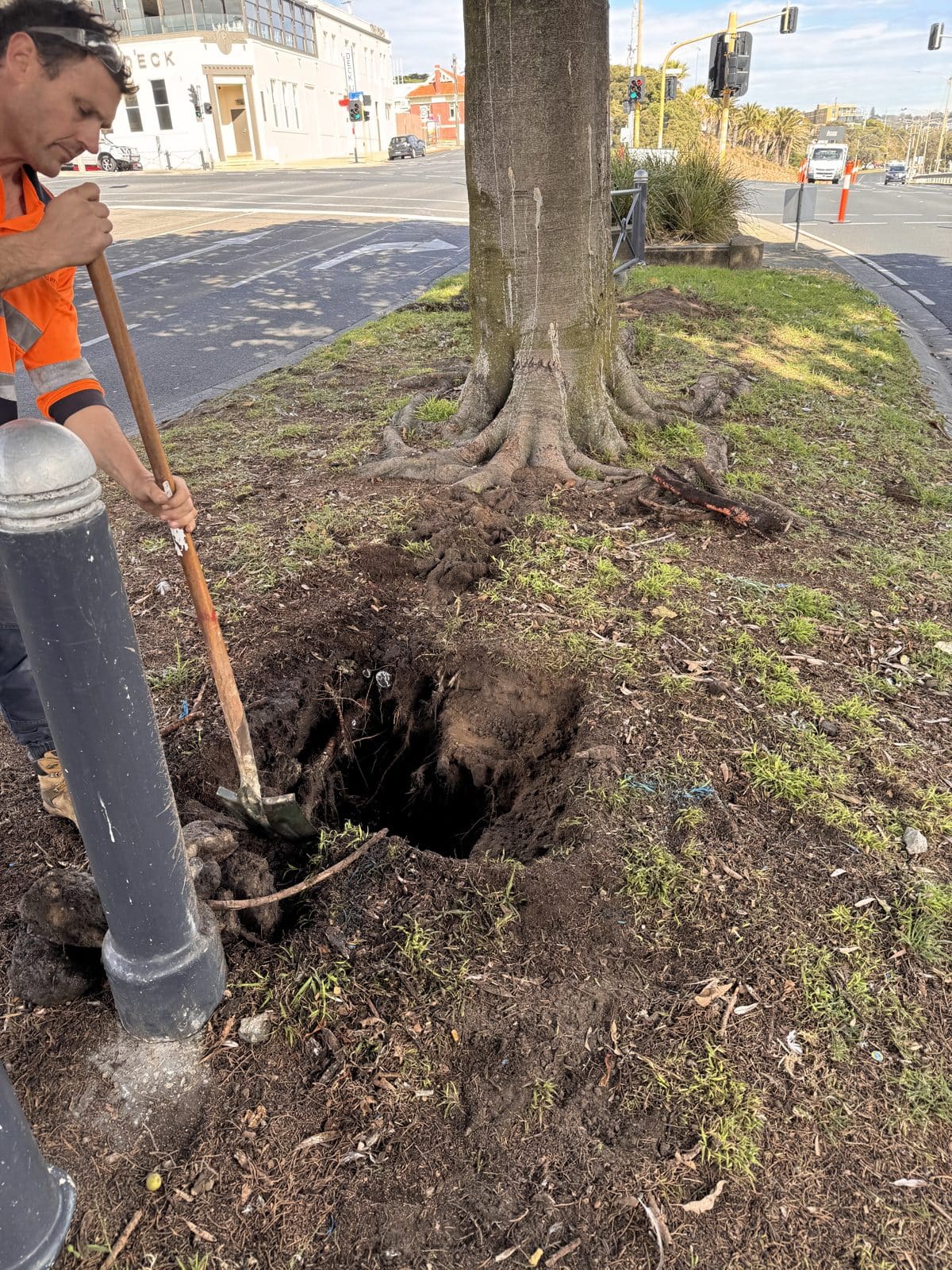
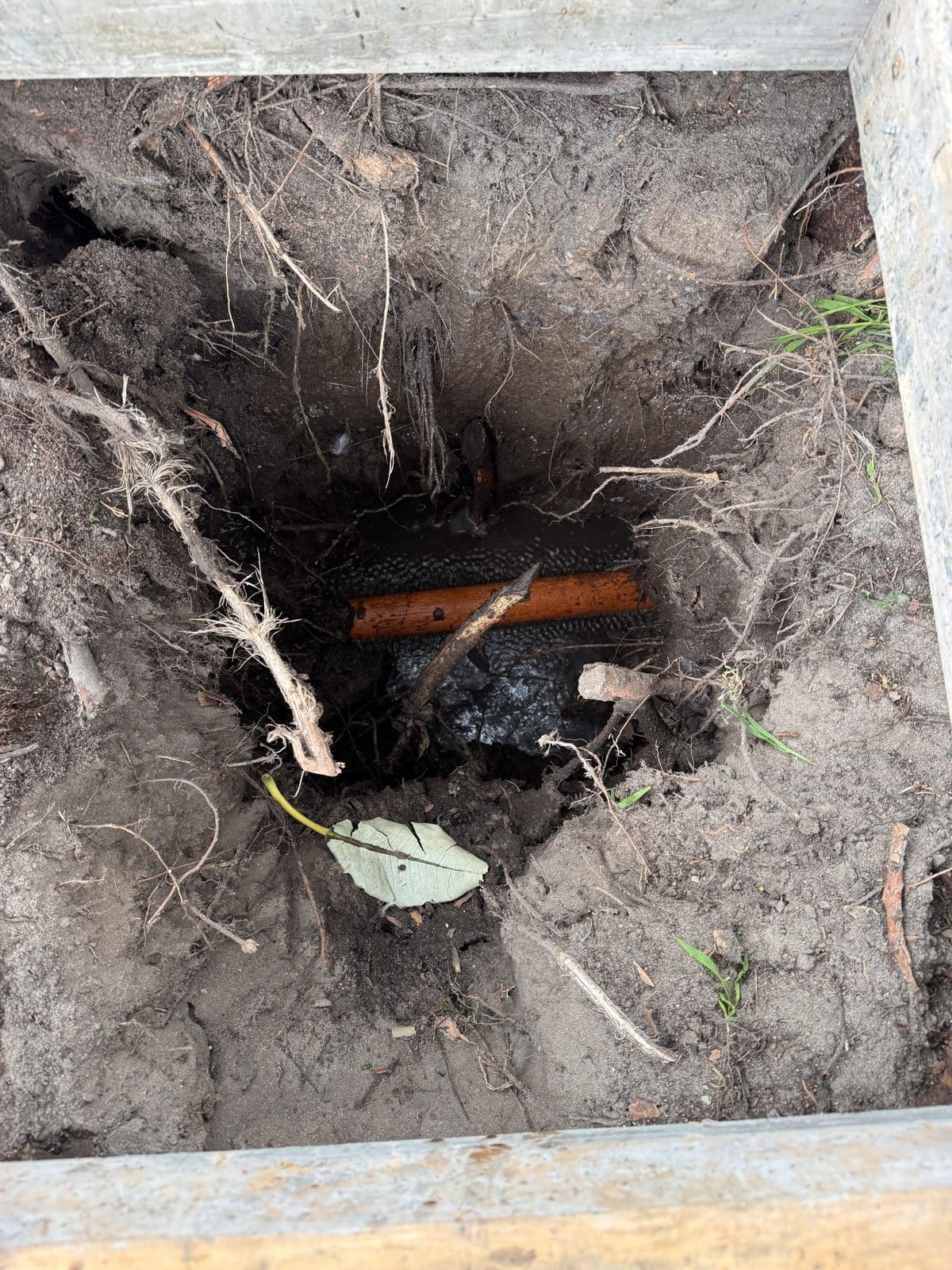
Final positions were set on site, not on a plan. Arbor Survey, the electrician and the drilling contractor worked it out at each pothole: where the housing and conduit could sit, which roots stayed, and which had to be cut. The few that had to be cut were pruned to AS 4373 under supervision (cl. 4.5.4). Pits were backfilled promptly and kept moist. The lights connected back to the electrical supply running under the median.
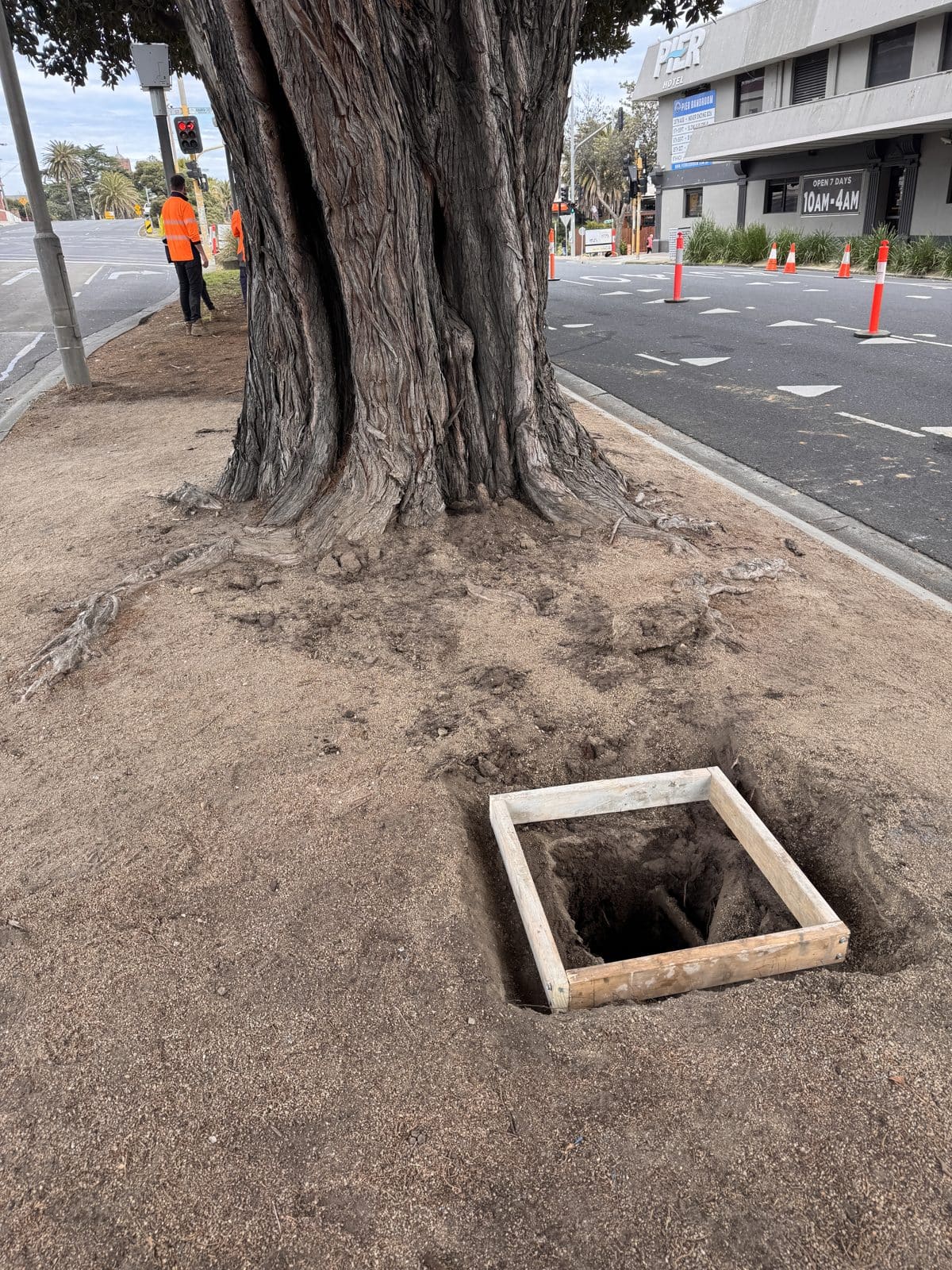
Arbor Survey supervised every stage, from the boring to the potholing to the connection. Someone was on site whenever the ground was open.
The outcome
Every tree survived with no impact on its condition. The lighting went in. The roots that mattered were either passed under by the bore or exposed by hand and worked around. Frankston got the lighting it wanted and kept the trees.
The takeaway
Boring under the roots and potholing by hand is not unique to Frankston. It is the approach AS 4970:2025 points to whenever a service has to cross a tree's root zone, and it should be used more than it is. We have written that up separately in Tree protection is boring, which covers directional drilling and NDD in the TPZ, what they do well, and where they hit limits.
The other point is continuity. Arbor Survey was involved from the first concept meeting through to the final connection. One consultant across the whole project, rather than one brought in late, is how a job this tight gets done while keeping the trees.
Sources
- AS 4970:2025 Protection of trees on development sites: cl. 3.2 (NRZ), cl. 3.4 (SRZ), cl. 3.3.2(m) (minimally destructive root investigation: pneumatic, hydraulic, hand digging, ground-penetrating radar), cl. 4.5.4 (root protection during work within the TPZ; AS 4373 pruning; prompt backfill; soil moisture), cl. 4.5.5 (installing underground services within the TPZ by directional drilling; bore upper surface at least 0.6 m deep and preferably outside the SRZ; assess launch and exit pit impacts).
- AS 4373 Pruning of amenity trees (root pruning standard referenced by AS 4970:2025 cl. 4.5.4).
Note. This article is general information, not site-specific advice.