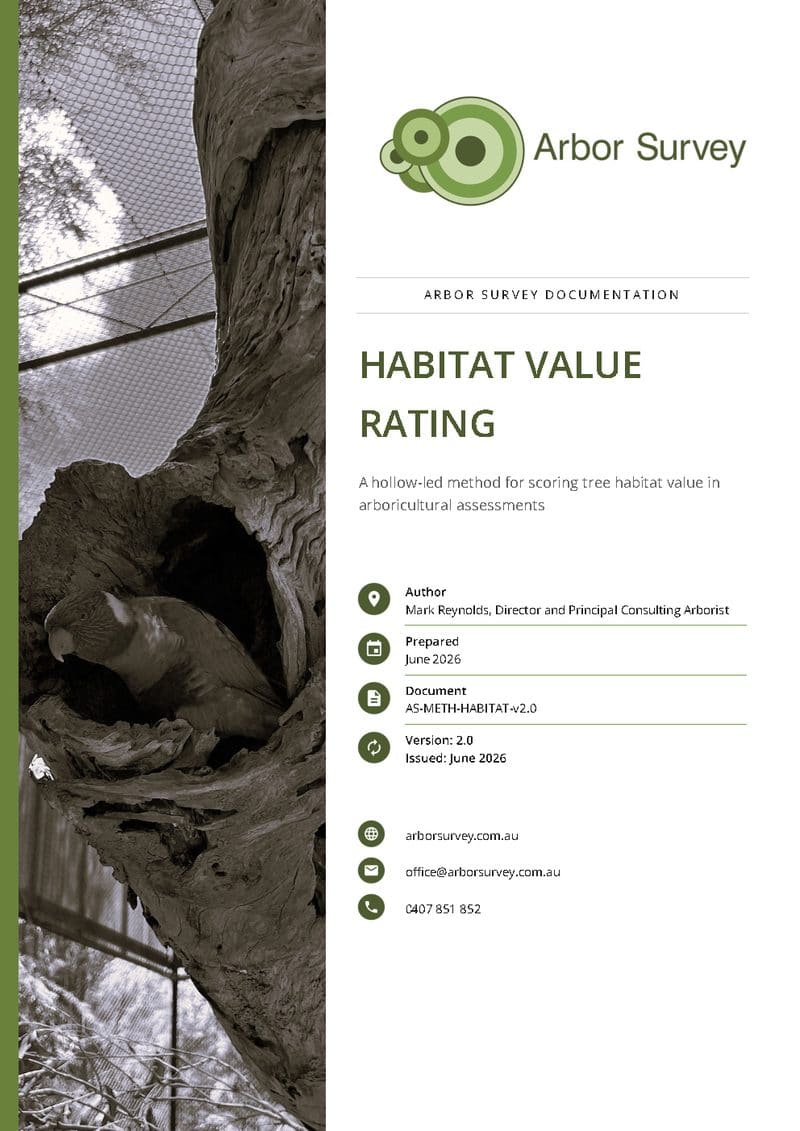
Our habitat value rating scores how much a tree matters as habitat, on a four-tier scale from Low to Very High. It is hollow-led: hollows, and a tree's potential to form them, set the tier. The rating is recorded in a single field in the tree data and feeds the retention priority for the tree.
Why it exists and when we use it
AS 4970:2025 frames tree assessment as the basis for retention and protection, but sets no method for scoring habitat value. This rating gives a repeatable, evidence-based way to make that call on site and to support it if it is challenged. It sits alongside the tree rating method, not inside it, as a separate axis: a tree can be low as a tree and high as a habitat, or the reverse, and both stay visible so the retention decision rests on each.
What it measures
The tier is set by four things: hollows and their size class, a tree's potential to form hollows in future, confirmed fauna use, and threatened-species status under the EPBC Act or the Victorian Flora and Fauna Guarantee Act. Other features, such as a food resource or a place in a connected canopy, are recorded as influencing factors that can move the rating by one tier, with a stated reason.
It is built around hollows for three reasons. Hollows are the habitat feature most clearly tied to the fauna that depend on trees and cannot use other structures; suitable hollows take a century or more to form, so a hollow-bearing tree is effectively irreplaceable on a human timescale; and hollows can be counted from the ground, which keeps the rating repeatable between assessors. A high habitat value raises a tree's retention priority; it does not, on its own, require retention in place.
What it is built on
Gibbons and Lindenmayer's work on tree hollows and wildlife conservation in Australia, the four hollow size classes from recent Australian hollow research (Woolley and others), and the large-tree benchmark from the Victorian Vegetation Quality Assessment, which sets a diameter threshold for each Ecological Vegetation Class rather than a single number. Where a rating is likely to be contested, we confirm the benchmark and the qualifying species with a VQA-accredited botanist.
Want more detail? Get in touch to discuss your project and how we can help.